Nvidia Geforce GTX 780 Ti & GTX 780 Thread

NVIDIA GeForce GTX 780 Ti overclocking exposed

Guys from Chiphell, as always before every important launch, have something to share with us. Today loshu1919 posted some overclocking results of his GeForce GTX 780 Ti sample.

http://videocardz.com/47690/nvidia-geforce-gtx-780-ti-overclocking-exposed

ZOTAC GeForce GTX 780 Ti pictured and detailed

ZOTAC is preparing two GTX 780 Ti models (ZT-70501 and ZT-70502), the difference lays in bundled games (Splinter Cell series), so don’t expect any custom Triple Silencer cooler just yet.

ZOTAC’s GTX 780 Ti is also reference based, so we are looking at yet another TITAN cooler reuse. The card itself is equipped with GK110 GPU with 2880 CUDA cores, 240 TMUs and 48 ROPs. It comes with 3GB GDDR5 memory and 384-bit interface.

ZOTAC:

Experience PC gaming like never before with surreal visuals and world-class performance with the ZOTAC GeForce GTX 780 Ti. The ZOTAC GeForce GTX 780 Ti ushers in the next generation of PC gaming with unmatched visual realism and performance for the most demanding gamers and enthusiasts.

NVIDIA 3D Vision Surround technology enables the ZOTAC GeForce GTX 780 Ti to drive up to three displays for high-quality triple display gaming with immersive stereoscopic 3D effects. NVIDIA 3-Way SLI readiness lets the most demanding enthusiast gamers combine up to three ZOTAC GeForce GTX 780 Ti graphics cards for up to a 280-percent performance boost.

ZOTAC GeForce GTX 780 Ti FEATURES

NVIDIA GPU Boost 2.0 technology
NVIDIA Adaptive Vertical Sync Technology
NVIDIA SMX shader architecture
NVIDIA PhysX technology
NVIDIA CUDA technology
NVIDIA 3D Vision Surround support
NVIDIA SLI ready (3-way-SLI)
NVIDIA SHIELD gaming-portable ready

ZOTAC GeForce GTX 780 Ti Specifications:

2,880 processor cores
3GB GDDR5
384-bit memory bus
Engine clock (base): 876 MHz
(boost): 928 MH
Memory clock: 7000 MHz
PCI Express 3.0 (compatible with 1.1)*
DisplayPort 1.2 (4K ready);  2 x DL-DVI; VGA (with included adapter); 1 x HDMI
700-watt power supply recommended
250-watt max power consumption
Microsoft DirectX 11.2 (feature level 11_0)
OpenGL 4.4

http://videocardz.com/47678/zotac-geforce-gtx-780-ti-pictured-detailed

PNY GeForce GTX 780 Ti pictured

PNY GeForce GTX 780 Ti gets a sexy XLR8 box.

PNY GTX 780 Ti (VCGGTX780T3XPB) is equipped with 2880 CUDA cores based on Kepler architecture. Card is featuring GK110 GPU clocked at 876/928 MHz. Just as all reference cards so far, also this has only 3GB GDDR5 memory. There’s no trace of other variations, so I’m guessing we will be seeing more custom cards later this month.

Card is listed at $699, so if someone was still hoping for lower price I suggest looking for other cards, or simply wait, since high-end GPU market has recently seen a huge fluctuation of the prices. Can these cards get any cheaper?

Other GTX 780 Ti cards:

Gigabyte GTX 780 Ti
Inno3D GTX 780 Ti
ZOTAC GTX 780 Ti

http://videocardz.com/47683/pny-geforce-gtx-780-ti-pictured

EVGA GeForce GTX 780 Ti SuperClocked at 1046 MHz

Despite having only this blurry picture I decided to post about this card, because this is the first overclocked GTX 780 Ti that Im am aware of.

UPDATE: Thanks to Ole fra trondheim we have more pictures of the EVGA lineup.

The fact that there is a SuperClocked model most likely means that EVGA also has more GTX 780 Ti cards. There is a chance that manufacturer will launch an ACX model as well, especially after this post on Instagram.

The EVGA GeForce GTX 780 Ti SuperClocked runs at 980 MHz, which is a base clock, the boost clock is 1046 MHz. That means it’s 118 MHz faster than other GTX 780 Ti that we’ve seen already. Of course also this card will use 3GB GDDR5 memory. It’s worth noting that GTX 780 Ti will support QUAD-SLI configurations.

http://videocardz.com/47725/evga-geforce-gtx-780-ti-superclocked-clocked-980-mhz

NVIDIA launches GeForce GTX 780 Ti

Today at 6AM PST NVIDIA will announce its new flagship — GeForce GTX 780 Ti. Of course NVIDIA didn’t even ask if we are interested in a sample, so just like always I will announce their card sooner than everyone else :slight_smile:

NVIDIA GeForce GTX 780 Ti specifications

The GeForce GTX 780 Ti is based on GK110-425 GPU, which packs 2880 CUDA cores, 240 Texture Mapping Units and 48 ROPs. This is a third installment of this processor in GeForce series following GeForce GTX 780 and GTX TITAN. Reference cards are using 3GB GDDR5 memory and 384-bit interface. I didn’t confirm yet if 6GB models will be released shortly after this announcement.

GeForce GTX 780 Ti has SKynix memory modules with a speed rated at 7 Gbps. The GPU is clocked at 875 MHz, with a boost clock at 928 MHz. Below you can see the picture of the memory module and the GPU itself.

The GPU-Z screenshot confirms everything that was mentioned above. On the right side you can see the official specs from NVIDIA document. Notice 960 double precision CUDA Cores. You can also see 250W TDP.

NVIDIA GeForce GTX 780 Ti power consumption and noise

Here’s a power consumption chart comparing GeForce GTX 780 Ti to Radeon R9 290X. As you can see, the difference is very small.

In terms of noise, also GTX 780 Ti is noticeably louder than both GTX 780 and GTX TITAN, you can hear it on the video below.

NVIDIA GeForce GTX 780 Ti overclocking

Just as I told you, GTX 780 Ti is loves overclocking. Here’s an example with 1274 MHz clock, more than 250 MHz additional power.

NVIDIA GeForce GTX 780 Ti price and availability

NVIDIA already announced that their new flagship will cost $699, which is around €669. Some retailers already have the cards, so make sure to check your favorite if he has any in stock.

NVIDIA GeForce GTX 780 Ti pictures →

http://videocardz.com/47719/nvidia-launches-geforce-gtx-780-ti

Nvidia Geforce GTX 780 Ti im Test: Die “Titan Ultra” ist gelandet - für 649 Euro

Geforce GTX 780 Ti im Test: 2.880 aktive Shader-Einheiten, ein Boost auf bis zu 1.006 MHz sowie 3 GiByte des schnellsten GDDR5-Speichers: Nvidia bläst zum Angriff auf die Radeon R9 290X. Welche High-End-Grafikkarte die Kühlerhaube vorn hat, klären wir im Test der Geforce GTX 780 Ti.

Wer in den vergangenen Wochen eine Geforce GTX 780 (Non-Ti) kaufte, kann sich womöglich freuen: Nvidia liefert seit einiger Zeit B1-Chips aus, die “inkognito” auf GTX-780- und sogar Titan-Grafikkarten zum Einsatz kommen. Obwohl Nvidia angibt, dass die Änderungen nicht über einen Metal Spin hinausgehen, hat ein GK110B praktische Vorteile gegenüber dem “alten” GK110: Ersten Nutzermeldungen zufolge lassen sich die B-Modelle überdurchschnittlich gut übertakten respektive undervolten – das trifft übrigens auch auf die Geforce GTX 780 Ti zu. Doch dazu später mehr.

Nvidias Geforce GTX 780 Ti ist nach der GTX Titan (PCGH-Test) und Geforce GTX 780 (PCGH-Test) die dritte Desktop-Grafikkarte auf Basis des GK110-Prozessors. Jener Grafikchip feiert zwar bald seinen ersten Geburtstag – die auf ihm basierende Tesla K20(X) wurde am 12.11.2012 vorgestellt –, erfuhr jedoch eine Überarbeitung: Mit der Geforce GTX 780 Ti wird der GK110 in Revision B1 offiziell, die ersten GTX-Titan- und GTX-780-Grafikkarten nutzen noch A1-Silizium. Nvidia bestätigte uns auf Nachfrage, dass dieser Spin (Überarbeitung der GPU) keine Performance-Verbesserungen oder neue Features wie Direct X 11.1 oder 11.2 einführt, GK110-B1 sei lediglich in den Disziplinen Fertigungsausbeute (Yields) und Taktpotenzial verbessert worden. Kurz und knapp: Auch die Geforce GTX 780 Ti unterstützt lediglich das DirectX-Featurelevel 11_0 sowie dessen optionale Funktionen. Letztere werden unter anderem von DICE für Battlefield 4 genutzt, sodass auch Kepler-Grafikkarten unter Windows 8(.1) mit DX11.1 effizienter arbeiten als unter DX11.0.

Laut Nvidia handelt es sich bei der Geforce GTX 780 Ti “um die beste GPU für Spieler, die jemals gebaut wurde”. Die Kalifornier betonen, dass diese Grafikkarte speziell auf PC-Spiele zugeschnitten ist, denn entgegen anders lautender Gerüchte bleibt die Geforce GTX Titan wegen ihrer zwei Vorteile gegenüber der GTX 780 Ti einstweilen auf dem Markt: Neben 6 anstelle von 3 GiByte Grafikspeicher sprechen die Double-Precision-Leistung (DP) von mindestens 1,3 TFLOPS für die derzeit 840 Euro GTX Titan – sofern der Interessent diese Vorteile semiprofessionell zu nutzen weiß. Spieler können darüber hinwegsehen, dass Nvidia die Geforce GTX 780 Ti auf ein DP-SP-Verhältnis von 1:24 beschnitten hat (Titan: 1:3), der kleinere Grafikspeicher kann jedoch in extremen Auflösungen und beim Einsatz von Grafikmods nachteilig werden. Zur Einstimmung auf die Testwerte packen wir die Geforce GTX 780 Ti aus:

Geforce GTX 780 Ti: GK110 bleibt GK110

Die Kepler-GK110-Gene wirken auch in der Geforce GTX 780 Ti. So besteht der auch der volle B1-Chip (GK110-425-B1) aus 15 SMX, von denen jeder 192 Shader-Einheiten, 16 Textureinheiten, das 64 KiB große Registerfile und verschiedene Caches beinhaltet. Für Tesla- und Quadro-Karten lässt sich optional ein ECC-Speicherschutz aktivieren sowie die Einteilung der 64 KiB L1-Cache/Shared-Memory in 16 KiB-Blöcken verändern (16:48, 32:32 und 48:16 KiB). Für Spieler zwar irrelevant, aber dennoch die größte Neuerung sind die 4x 16 DP-Einheiten, welche laut Nvidia als physisch separate ALUs implementiert wurden. Die restlichen GK110-Goodies wie Hyper-Q, Dynamic Parallelism, erweiterte Virtualisierung und vor allem der neue “fast path”, um Speicherwerte über Zweckentfremdung des Texturcaches einzulesen, ihn also als Read-Only-L1-Cache zu missbrauchen, erfordern spezielle Programmierung und Optimierung auf den GK110-Chip. Zum Teil stehen sie auch nur unter CUDA zu Verfügung.

Die SMX sind in fünf Gruppen, die Graphics Processing Cluster (GPCs), organisiert. Diese beherbergen die Rasterizer, von denen jeder acht Pixel pro Takt schafft. Insgesamt 40 Pixel pro Takt, ergo 33,48 Gpix/s als GTX Titan und 34,7 GPix/s als GTX 780 (allerdings mit 5 GPCs!), kann der GK110 folglich an die ALUs weitergeben. Das ist nur wenig mehr als beispielsweise GTX 680 und HD 7970 erreichen und könnte sich als Flaschenhals des gigantischen Chips erweisen. Die kleineren Chips gleichen den geringeren Durchsatz (32 pixel per clock) mit höherem Takt jenseits von 1 GHz aus.

Der bei GK110 entweder 3 (GTX 780 & Ti) oder 6 GiByte (GTX Titan) große Speicher hängt an sechs 64 bit breiten Controllern mit je einer “Octo”-ROP-Partition. Hier gibt es die nächste für Spieler vielleicht interessante Änderung zum GK104: Anstelle von 128 entlasten nun 256 KiB lese-/schreibfähiger Level-2-Cache die GDDR5-Bausteine. Damit ist die Geforce GTX 780 Ti wie auch die GTX 780 und Titan etwas unabhängiger von der Speichertransferrate als beispielsweise die Geforce GTX 680/770. Das unterstreichen zahlreiche Praxis-Benchmarks von PC Games Hardware.

http://www.pcgameshardware.de/Geforce-GTX-780-Grafikkarte-257241/Tests/Geforce-GTX-780-Ti-Test-1096105/

Laut den Benchmarks ist die Ti natürlich paar % vorn, aber das Fazit bei PCGH irritiert mich dann doch etwas.

Nvidia Geforce GTX 780 Ti: Modell von Zotac in Österreich ab 677 Euro gelistet

Noch heute will Nvidia seine neueste Grafikkarte auf Basis der altbekannten GK110-GPU offiziell veröffentlichen, wobei nun schon die erste Listung in unserem Preisvergleich vorgenommen worden ist. Dies betrifft aktuell lediglich unsere österreichischen Nachbarn, wo die Geforce GTX 780 Ti ab rund 677 Euro vorbestellt werden kann - lieferbar ist das Modell von Zotac noch nicht.

Nachdem Nvidia die Geforce GTX 780 Ti erstmals am 18. Oktober angekündigt hat, gab der Grafikkartenhersteller 10 Tage später bekannt, dass der Pixelschubser heute für 699 US-Dollar an den Start gehen werde. Da dies offensichtlich noch nicht geschehen ist, gehen wir davon aus, dass dies noch im Laufe des Tages geschehen könnte, da es bisher keine anderweitigen Meldungen gibt. Dafür spricht auch die aktuelle Entwicklung in unserem Preisvergleich.Gestern erst hatten wir darüber berichtet, dass Nvidia die Geforce GTX Titan auslaufen lassen könnte, da der Preis gestiegen und die Verfügbarkeit gesunken ist.

Nun ist die erste Geforce GTX 780 Ti aufgetaucht, welche in diesem Fall vom Boardpartner Zotac stammt. Obwohl die Preisempfehlung umgerechnet mit der österreichischen Mehrwertsteuer von 20 Prozent etwa 620 Euro beträgt, kostet die Grafikkarte dort mindestens 677 Euro. Man kann davon ausgehen, dass die Preise nach der offiziellen Einführung, spätestens wenn der Pixelbeschleuniger großflächig verfügbar sind, noch fallen werden. Alle drei Onlinehändler haben die Geforce indes noch nicht lagernd. Allerdings wird bei einem ein voraussichtlicher Liefertermin vom 29. November angegeben.

Es bleibt also abzuwarten, ob es sich um einen sogenannten Paperlaunch seitens Nvidia handeln wird, oder ob die Geforce GTX 780 Ti bei anderen Shops früher verfügbar sein wird. Auch soll es später Gerüchten zufolge noch eine “Special Edition” mit schwarzem Kühler geben, bei der 6 respektive 12 GiByte GDDR5-VRAM zum Einsatz kommen. Außerdem soll dort eine “unlimited” TDP vorhanden sein. Worum es sich dabei genau handelt, ist aktuell noch nicht bekannt.

http://www.pcgameshardware.de/Nvidia-Geforce-Grafikkarte-255598/News/Zotac-Geforce-GTX-780-Ti-Oesterreich-gelistet-1096203/

ASUS GeForce GTX 780 Ti pictured

ASUS is preparing one reference based GeForce GTX 780 Ti for tomorrow.

ASUS GeForce GTX 780 Ti (GTX780TI-3GD5) features GK110 GPU with 2880 CUDA cores. Card is equipped with 3GB GDDR5 memory across 384-bit interface. Fortunately or not, it’s only reference based, and so far there is no trace of custom cards.

You can clearly see that ASUS has put DirectX 11.2 support on the box, so I guess this is official now.

http://videocardz.com/47722/asus-geforce-gtx-780-ti-pictured

MSI announces GTX 780Ti graphics card

The new MSI GTX 780Ti ties incredible performance and power efficiency into one great product. Boost your gaming experience with a stunningly beautiful, quiet design. With NVIDIA GPU Boost 2.0 you get maximum clock speeds while PhsyX and TXAA technologies give smooth, sharp graphics. Whether you’re playing on stunning 4K monitors at extreme settings or multiple monitors at 2560×1600/2560×2440, the GTX 780 Ti provides horsepower to drive all of today’s most demanding games. The GTX 780Ti also is ready for 3D displays and is supported by GeForce Experience which automatically optimizes your games for optimum performance.
MSI_GTX780Ti_specs

Cutting Edge Technologies
The MSI GTX 780Ti is filled to the brim with technology that improves your gaming experience. The recently announced NVIDIA G-SYNC is fully supported and removes tearing and reduces input lag. Streaming your games to a NVIDIA SHIELD gaming console allows you to play your favorite PC game on this portable console. GeForce Experience takes the hassle out of configuring your games for optimum performance and ShadowPlay which automatically captures your favorite gaming moments. The GTX 780Ti can be run in 3-way SLI configurations for maximum performance.

http://videocardz.com/47759/msi-announces-gtx-780ti-graphics-card

Gigabyte launches GeForce GTX 780 Ti with WindForce 3X cooler

Gigabyte is pleased to announce the latest graphics card, GeForce GTX 780 Ti Overclock Edition (GV-N78TOC-3GD). With 25% plus CUDA cores than GTX 780, the most powerful thermal design in the world and exciting new technologies, GV-N78TOC-3GD is going to bring all the gamers an extremely gaming experience to a whole new level. The exclusive WINDFORCE 3X cooling design guarantees you to dissipate 450 watt heat out.

Enjoy your game play with a stunningly beautiful and quiet design is no longer a dream.

It also supports OC GURU II and GPU Boost 2.0 for maximum clock speeds. GV-N78TOC-3GD features PhysX® and TXAA technologies for smooth, sharp graphics, and GeForce ShadowPlay to capture all your greatest gaming moments automatically. Whether you play on 4K monitors at extreme settings, GV-N78TOC-3GD can provide the horsepower to drive all your next-gen gaming visual experiences. NEW WINDFORCE 3X 2-SLOT 450W cooling system,14% cooler than stock fan!

GIGABYTE innovatively presents WINDFORCE 3X 2-SLOT cooling system, thinner and cooler! The thermal structure contains three ultra quiet PWM fans, an only 2-slot height heat sink with exclusive “Triangle Cool” Technology, two 8mm and four 6mm cooper heat pipes and a high-performance RAM heatsink.

The innovative thermal design guarantees the heat dissipation capability to over 450watt. The cooling performance is 14% significantly better than stock fan! WINDFORCE 3X 450W cooling system not only provides an effective heat dissipation capacity, but also gained a higher performance with lower GPU temperature through the GPU Boost 2.0 technology. 2 Instinctive User Interface Software – OC GURU II According to the latest NVIDIA® technology, GPU BOOST 2.0, GV-N78TOC-3GD provides gamers an unlimited overclocking capability. By using GIGABYTE exclusive OC GURU II, gamers can monitor and adjust all important settings such as GPU clock, memory clock, fan speed, voltage, power target, OSD and online support. With the upgrade and easy-to-control user interface, GIGABYTE OC GURU II becomes the best mate while using GV-N78TOC-3GD.

http://videocardz.com/47769/gigabyte-launches-geforce-gtx-780-ti-windforce-3x-cooler

EVGA launches GeForce GTX 780 Ti, including Classified and SuperClocked models

Pure Performance Accelerated

The EVGA GeForce® GTX 780 Ti is the best gaming GPU on the planet, delivering 25% more cores and exciting new technologies to take extreme gaming to a whole new level. This is pure performance accelerated, giving you the freedom to play every title at ultra settings and max resolutions on today’s highest-definition displays.

Boost your gaming experience with a stunningly beautiful, quiet design. You get NVIDIA GPU Boost 2.0 for maximum clock speeds, PhysX® and TXAA™ technologies for smooth, sharp graphics, and GeForce ShadowPlay™ to capture all your greatest gaming moments, automatically. Whether you’re playing on stunning 4K monitors at extreme settings, or multiple monitors at 2560×1600, the GTX 780 Ti provides the horsepower to drive all your next-gen gaming visual experiences.

Of course, when paired up with EVGA’s Award Winning ACX Cooling, you get reduced temperatures, silent operation, and best of all, unbelievable overclocking potential!

http://videocardz.com/47777/evga-launches-geforce-gtx-780-ti

KFA2 launches GeForce GTX 780 Ti

KFA2 announced today the KFA2 GeForce GTX 780 Ti, built with 25% more cores and exciting new technologies to take extreme gaming to a whole new level. Blazing fast 7GHz GDDR5 memory and 2880 cores deliver the horsepower needed to play the most demanding games at ultra settings and extreme resolutions.

NVIDIA G-Sync is one of the most revolutionary new technologies to be featured in the GTX 780 Ti, completely eliminating screen tearing, input lag and stuttering when paired with a G-Sync Ready display. GeForce ShadowPlay lets you capture all your greatest gaming moments automatically, and NVIDIA GPU Boost 2.0 ensures your GPU operates at the pinnacle of its potential at all times. 4-way SLI support allows multi-GPU scaling for maximum detail levels with smooth frame rates in even the most demanding configurations such as 4K and triple 1440p Surround. The GTX 780 Ti also introduces Microsoft DirectX 11.2 and OpenGL 4.4 compatibility, adding support for the latest state of the art effects featured in the newest games and applications.

“ Yet again a new level of performance has been set with GeForce 780 Ti, with 2880 cores and 7GHz of memory this card has enough horsepower to handle any future 4K game play”

http://videocardz.com/47764/kfa2-launches-geforce-gtx-780-ti

Palit announces GeForce GTX 780 Ti

Palit Microsystems Ltd, the leading graphics card manufacturer, releases the powerful new Palit GeForce GTX 780 Ti and its adding more than just state-of-the-art features and technology on the Kepler Family. The new GeForce GTX 780 Ti is the best gaming GPU on the planet, delivering 25% more cores and exciting new technologies to take extreme gaming to a whole new level. This is pure performance accelerated, giving you the freedom to play every title at ultra settings and max resolutions on today’s highest-definition displays.

Palit GeForce GTX 780 Ti features a massively powerful NVIDIA Kelper-based GPU with 2880 cores-25% more cores and 25 % higher performance than GTX 780. Plus, it comes with 7GHz of high-speed GDDR5 memory and implemented with the new NVIDIA G-SYNC/SHIELD ready technology, giving you the performance capabilities you need to game at extreme settings.

The essence of “The Best Gaming GPU” of Palit GeForce GTX 780 Ti, made real with a wide range of advanced technologies and features:

NVIDIA Kepler GPU with 2880 cores
Next-generation Kepler-architecture-based GPU
3GB 7GHz high-speed GDDR5 memory for high-resolution gaming
NVIDIA GPU Boost 2.0 technology
NVIDIA 3 way SLI-Ready
NVIDIA G-SYNC Ready
NVIDIA SHIELD Ready

The GeForce GTX 780 Ti is more than just fast and smooth. It perfectly boosts your gaming experience with a stunningly beautiful, quiet design. You get NVIDIA GPU Boost 2.0 for maximum clock speeds, PhysX and TXAA technologies for smooth, sharp graphics, and GeForce ShadowPlay to capture all your greatest gaming moments, automatically. Whether you’re playing on stunning 4K monitors at extreme settings, or multiple monitors at 25 x 16, the GTX 780 Ti provides the horsepower to drive all your next-gen gaming visual experiences. Palit GeForce GTX 780 Ti is the flagship GPU of the GTX700 Series platform. It offers insanely performance to give hardware enthusiasts and extreme PC gamers the ideal gaming experience.

Palit understands the gamers’ needs, this original board design will never satisfy gamers appetite. To ensure the extreme performance and stability, Palit will soon provide an own design GeForce GTX 780 Ti JetStream performed maximum performance and better thermal solution.

http://videocardz.com/47789/palit-announces-geforce-gtx-780-ti

Gainward announces GeForce GTX 780 Ti

As the leading brand in enthusiastic graphics market, Gainward proudly presents the Next-generation Kepler-architecture-based graphics card from Nvidia – GTX 780 Ti 3GB. Gainward GeForce GTX 780 Ti is the king of the GTX 700 Series platform. It offers unbeatable performance, smooth, and also whisper-quiet acoustics to give hardware enthusiasts and extreme PC gamers the ideal gaming experience.
The GeForce GTX 780 Ti is the best gaming GPU on the planet, delivering exciting new technologies to take extreme gaming to a whole new level. This is pure performance accelerated to the extreme, giving you the freedom to play every title at ultra settings and max resolutions on today’s highest-definition displays.
Gainward GeForce GTX 780 Ti is powered by 2880 cores which is 25% more cores than GTX 780 and 16.5% more memory bandwidth with 7GHz memory ICs. The Gainward GeForce GTX 780 Ti is superior performance to any competitive GPU. This is the essence of “The fastest single-GPU graphics card”.

Beside NVIDIA GPU Boost 2.0 for maximum clock speeds, PhysX and TXAA technologies for smooth, sharp graphics, the GeForce Experience allows users to optimize the game settings to their PC with a single click. And the new GeForce ShadowPlay allows users to capture all your greatest gaming moments, automatically. Whether you’re playing on stunning 4K monitors at extreme settings, or multiple monitors at 2560 x 1600, the GeForce GTX 780 Ti provides the horsepower to drive all your next-gen gaming visual experiences.

Gainward, of course, will introduce GeForce GTX 780 Ti Phantom series to the market as well. With Gainward superior hardware design, users will experience blockbuster games with superlative gaming thrills and enjoy exceptional fill of the performance enhanced and quieter gameplay.

http://videocardz.com/47792/gainward-announces-geforce-gtx-780-ti

Inno3D announces GeForce GTX 780 Ti lineup

Hong Kong 7th November, 2013 – The Inno3D and iChill GeForce GTX 780 Ti is a step up from the previous GTX 780 powerhouse. The gaming performance is incredibly fast, smooth, and whisper-quiet while it’s also extremely overclocked. It features a massively powerful NVIDIA Kepler™ GPU of 2880 cores—20% more than the GTX 780. Plus, it comes with 3 GB of high-speed GDDR5 memory and NVIDIA GPU Boost 2.0 technology, giving you the performance capabilities you need to game at extreme settings.

The GTX 780 Ti is more than just fast and smooth. It’s perfectly tuned to today’s most advanced gaming technologies with features like GeForce Experience™ for one-click driver and settings optimization, plus NVIDIA® PhysX® and TXAA™ for smooth, sharp graphics.

http://videocardz.com/47795/inno3d-announces-geforce-gtx-780-ti-lineup

ol.JPG

ol.JPG_thumb

Nvidia Geforce GTX 780 Ti: Hersteller stellen ihre Modelle vor - Custom-Designs ab Dezember

Nachdem Nvidia gestern um 15:00 Uhr offiziell seine Geforce GTX 780 Ti vom Stapel gelassen hat, welche mit einem Vollausbau des GK110 daherkommt, sind bereits zahlreiche Einträge in unserem Preisvergleich vorhanden. Für ein lieferbares Exemplar werden mindestens 623 Euro fällig, wobei die Verfügbarkeit eher mager aussieht. Auch hier sollen Custom-Designs erst ab Dezember verfügbar sein.

Gestern um 15:00 Uhr hat Nvidia die Geforce GTX 780 Ti offiziell veröffentlicht, woraufhin nun logischerweise die Listungen in unserem Preisvergleich folgen. Aktuell sind dort 11 verschiedene Modelle von Asus, EVGA, Gainward, Gigabyte, Inno3D sowie Zotac vorhanden. Obwohl die Preisempfehlung hierzulande bei 649 Euro liegt, wird das günstigste Pendant mit rund 616 Euro beziffert, was allerdings nur auf einen Shop zutrifft. Das Gros der Händler ruft hingegen den veranschlagten Preis von Nvidia auf, wobei alle Grafikkarten noch im Referenzdesign gehalten sind.

Wie schon bei AMDs Radeon R9 290X sowie der kleineren Schwester ohne X-Suffix sollen Custom-Designs Ende des Jahres folgen. Inno3D hat die Geforce GTX 780 Ti mit HerculeZ-2000- sowie HerculeZ-X3-Kühlung angekündigt, welche laut Caseking ab dem 02. Dezember erhältlich sein sollen. Der Kostenpunkt liegt bei 669 respektive 699 Euro. EVGA wird verschiedene Modelle mit ACX-Kühlung auf den Markt bringen, darunter wieder eine Classified-Version. Auch Gigabyte hat bereits seine Windforce-3X-Version angekündigt. Es dürfte also vor Weihnachten noch einen regen Schlagabtausch zwischen den Boardpartnern von Nvidia sowie AMD geben.

Nichtsdestotrotz verzichten manche Boardpartner auch hier trotz des Referenzkühlers nicht auf eine Übertaktung ab Werk. Momentan bietet EVGA mit seiner Superclocked-Version für 679 Euro das schnellste Modell, bei welcher die GK110-425-B1-GPU mit 980/1.046 MHz (Basis/Boost) rechnet. Der Speicher bleibt indes mit 3.500 MHz unangetastet. Wir rechnen damit, dass in naher Zukunft noch andere Hersteller mit ähnlich hohen Taktraten nachziehen werden - spätestens wenn die Custom-Designs erscheinen.

Insgesamt scheint die Verfügbarkeit der Geforce GTX 780 Ti genauso wie bei der AMD Radeon R9 290X, deren Leistung in etwa gleich ausfällt, zu Beginn auszufallen, wenn nicht sogar noch schlechter. Viele Händler haben nur wenige Exemplare auf Lager, wobei vielerorts erst in wenigen Wochen Nachschub vorhanden sein soll. Die GTX 780 Ti aus dem Hause Gigabyte scheint am meisten vorhanden zu sein. Bei AMDs Flaggschiff waren zumindest zu Beginn einige Pixelschubser verfügbar, die mittlerweile zum Großteil ausverkauft sind.

http://www.pcgameshardware.de/Nvidia-Geforce-Grafikkarte-255598/News/Nvidia-Geforce-GTX-780-Ti-Hersteller-Modelle-vorgestellt-1096345/

Geforce GTX 780 Ti: Was sagen die nationalen Kollegen zum neuen Nvidia-Topmodell?

Einige Stunden sind seit Nvidias Veröffentlichung der Geforce GTX 780 Ti vergangen, die in unserem Test mit AMDs Radeon R9 290X in etwa gleichzieht, aber besonders bei der Referenzkühlung überzeugender daherkommt. Nun haben wir uns die Zeit genommen, um uns die Ergebnisse der deutschen Kollegen etwas näher anzusehen.

Bereits bei der AMD Radeon R9 290X haben wir unsere Ergebnisse mit denen der anderen Tester verglichen, die grundsätzlich auf das gleiche Fazit gekommen sind: Die Grafikkarte weiß leistungstechnisch zu überzeugen, schreckt aber durch die schlechte Referenzkühlung ab. Nun wollen wir Ihnen eine Übersicht über Nvidias Geforce GTX 780 Ti gewähren, welche von den Kollegen durch die Bank weg trotz der hohen Leistung für die vergleichsweise niedrige Lautstärke gelobt wird.

Selbiges konnten auch wir feststellen, wobei die Performance mit 100 Prozent Powertarget auf dem Niveau der Radeon R9 290X im Uber-Modus liegt. Die Leistungsaufnahme ist dabei mit maximal 250 Watt einige Watt unter der Konkurrenz. Stellt man das Powertarget auf die maximalen 106 Prozent und auch das Temperaturlimit um einige Grad auf der Celsius-Skala nach oben, zieht die Geforce GTX 780 Ti um wenige Prozentpunkte weiter, erreicht dabei aber auch eine entsprechend höhere Leistungsaufnahme.

Im Test von Computerbase wurden in etwa die gleichen Werte erzielt. So war die GK110-GPU durchschnittlich einige Megahertzchen schneller als Nvidia beim Boost-Modus im Mittel angibt. Stellt man Power- sowie Temperatur-Target hoch, wurde dort der exakt selbe Wert von 1.006 MHz erreicht. Im Fazit wird auch dort erörtert, dass Nvidia in niedrigeren Auflösungen, wie Full-HD, die Nase vorn hat, AMDs Hawaii-Pendants aber in höheren Auflösungen deutlich aufholt.

Die Kollegen von Golem legen in ihrem Resümee den Fokus auf das Referenzdesign: “Wer sich schon für eine Radeon R9 290 oder 290X entschieden hat oder das noch vorhat, kann nur neidisch auf die 780 Ti schielen, wenn die Lautstärke und das für die AMD-Karten nötige Feintuning am eigenen PC eine Rolle spielen.” Allerdings wird dort Kritik an die hohe Preisgestaltung geäußert, welche bei AMD positiver ausfällt. Außerdem geht man dort auf die gesunkenen Preise bei der Mittelklasse durch den scharfen Konkurrenzkampf im High-End-Segment ein.

Sowohl Golem als auch Tom’s Hardware ist die knapp kalkulierte Speicherkapazität von lediglich 4 GiByte aufgefallen, welche sowohl bei der Geforce GTX Titan als auch der Radeon R9 290(X) höher ausfällt. Letztere Webseite empfiehlt das günstigere Produkt aus dem Hause AMD, insofern man die Ketten in Form der schlechten Kühlung löst. Worauf keiner der deutschen Kollegen eingeht, sind die unterschiedlichen Ökosysteme, wobei AMD mit Mantle scheinbar noch ein “Ass” im Ärmel hat.

http://www.pcgameshardware.de/Nvidia-Geforce-Grafikkarte-255598/News/Geforce-GTX-780-Ti-Testzusammenfassung-1096479/

Colorful iGame GeForce GTX 780 Ti detailed

Colorful showcased its latest GeForce graphics card based on GK110 GPU.

This is actually the first fully custom GeForce GTX 780 Ti you are about to see in detail. Card does not only feature custom cooling solution but also a fully modified board. Card is also factory overclocked to 1006/1076 MHz, but the memory has been left at stock speed (7 GHz). Similar to Inno3D’s HerculeZ cooler, the iGame cooler has three 90nm fans. This is actually a triple-slot design, not necessarily the best solution if you were planning to SLI them.

Moving on to the PCB itself, we have 12+2 phase power design, which is more than reference 6+2. Luckily Colorful thought about equipping this card with two 8-pin power connectors, so overclocking should not be a problem.

In terms of additional features, it’s worth noting the backplate and the special BIOS switch on the bracket, possibly rising the clocks even further.

http://videocardz.com/47841/colorful-igame-geforce-gtx-780-ti-detailed

Custom GeForce GTX 780 Ti from Gigabyte and Inno3D tested

Guys from ComputerBase had the opportunity to test two custom GeForce GTX 780 Tis from Gigabyte and Inno3D. Both are based on reference PCBs, but feature custom cooling solutions.

On the contrary to MSI Lightning, EVGA Classfied or ASUS DirectCU 2 TOP these cards have only new cooler, rather than custom boards. ComputerBase tested Gigabyte GeForce GTX 780 Ti Overclock Edition and Inno3D GeForce GTX 780 Ti iChill Herculez Ultra X3 (someone has to work on these Inno3D names). Both cards are overclocked out of the box, the Gigabyte is running at 1020/1085 MHz, while Inno3D runs at 1006/1046 MHz. Also these cards have overclocked memory to effective 7200 MHz. The Geforce GTX 780 is using GK110-425-B1 GPU with 2880 CUDA cores, it’s is currently the fastest single-GPU card on the market. The two cards from this test were even faster than GTX 690.

There are some other differences between these cards. While both feature 3 triple-fan coolers, one is actually dual-slot (Gigabyte) and Inno3D’s is triple-slot. Also the Inno3D’s solution features larger fans (90mm vs 80mm). Usually larger fans can deliver the same airflow while generating lower noise.

Probably the most disappointed part of these cards are 6-pin and 8-pin power connectors. You would expect more advanced power delivery options in such a high-end graphics card.

The tests

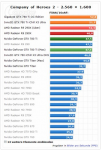
I’m not including all charts from their review, but there aren’t many. ComputerBase did not include Battlefield 4 in their test, instead they used Project Cars, one of the most demanding titles on the market, but CB will no longer add this game to their tests, I guess that’s due to poor optimization. I found Company of Heroes 2 results interesting, since in many of reviews Radeon R9 290X could easily compete with GTX 780 Ti in this game. With the arrival of custom cards this is no longer a valid statement.

In 2560×1600 resolution custom GTX 780 Ti cards are on average 15% faster than reference model. In comparison to R9 290X we are looking at 18% performance gap. This is a huge difference, but it’s probably only Radeon cooler to blame. Custom R9 290X should perform much better and these, even in engineering sample state, were not included in this comparison.

Note: Radeon R9 290(X) cards were tested with Catalyst Beta 8, not the latest Beta 9.

http://videocardz.com/47831/custom-geforce-gtx-780-ti-gigabyte-inno3d-tested

g1.JPG

g1.JPG_thumb

g2.JPG

g2.JPG_thumb